
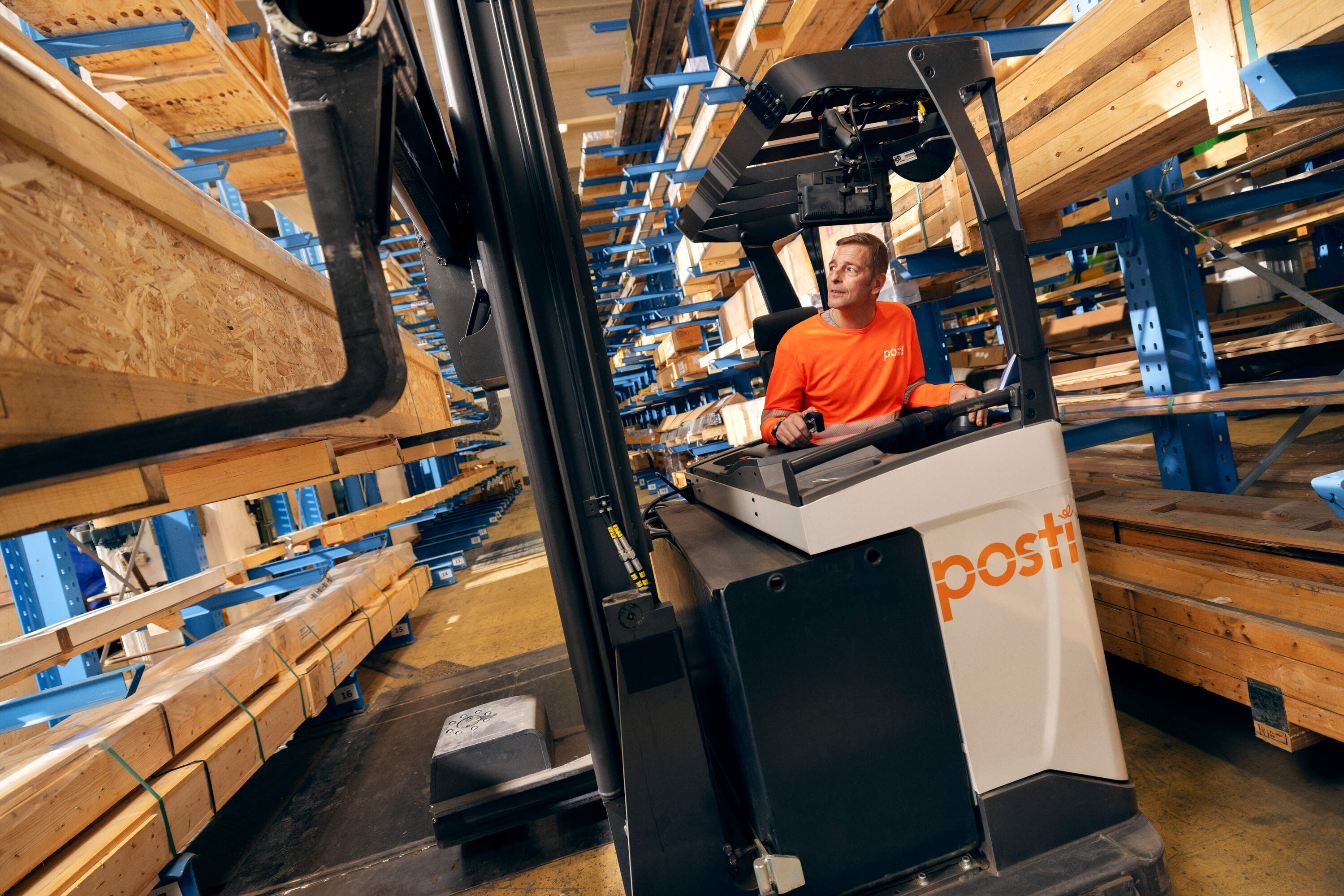
Many companies know their production costs in detail, but far fewer can say how efficiently their on‑site logistics operate. When material flows begin to be measured and developed systematically, significant opportunities often emerge to reduce costs, speed up deliveries and free up resources for core business. Depending on the starting point, outsourcing on‑site logistics can generate cost savings of up to 10–40 percent.
Summary of the article:
On‑site logistics directly affect delivery reliability, costs and production efficiency.
Outsourcing on‑site logistics can deliver 10–40 percent cost savings depending on the initial situation.
Data and performance metrics help identify bottlenecks and develop material flows more effectively.
With Posti, companies can access on‑site logistics, transport, warehousing, packaging solutions, customs clearance and staffing services from a single partner.
On‑site logistics may appear to be a background process, but its impact is visible throughout the supply chain, production efficiency and customer experience. Often the greatest development potential lies in processes that are not examined closely enough in the midst of everyday operations.
Harri Petjala, Head of On‑Site Logistics at Posti, believes that developing on‑site logistics begins with understanding the current state.
“Many companies know their production costs precisely, but the true costs or efficiency of on‑site logistics may never have been measured as a whole. As a result, development potential easily remains hidden.”
Inefficient on‑site logistics quickly show up on the bottom line
In many companies, on‑site logistics remain overshadowed by production and sales. Yet their impact is visible across the entire supply chain.
When materials do not move smoothly, production must wait for components, delivery times become longer and more capital is tied up in inventory. At the same time, delivery reliability weakens and customer experience suffers. In the worst case, the effects can be seen in the company’s competitiveness and sales.
Many companies also struggle with volume fluctuations. Seasonal peaks, demand surges and production changes make resource planning difficult. Costs can easily rise without a corresponding improvement in service levels.
What are the benefits of outsourcing on‑site logistics?
Outsourcing on‑site logistics gives companies access to logistics professionals, efficient processes, the right equipment and a measured operating model. At the same time, the company can focus more effectively on its core business.
One of the most significant benefits relates to cost structure. Outsourcing turns fixed personnel and equipment costs into more flexible expenses that adapt to actual volumes.
Harri Petjala emphasizes that outsourcing is about much more than transferring resources to a partner.
“Outsourcing on‑site logistics is not just about shifting resources to a partner. The goal is to make operations more efficient, flexible and predictable. When resources are dimensioned according to actual needs, significant savings often follow.”
Small changes can deliver major benefits
Concrete benefits often appear in everyday work. Even small changes can generate significant savings in working time, material costs and delivery quality.
In one development project, the packaging process was redesigned so that special‑sized boxes were replaced with standard‑sized packaging. As a result, the number of boxes used decreased by around 500 per year. Packaging time was reduced by 15 minutes per box, saving approximately 3,200 working hours annually.
In another project, a new warehouse management system improved warehouse efficiency by 8.1 percent and significantly reduced inventory errors and incorrect deliveries.
Data reveals where the development potential lies
When material flows are measured and monitored in real time, bottlenecks can be identified, resource needs anticipated and operations developed based on facts. Data also helps improve throughput times, delivery reliability and cost efficiency.
According to Petjala, data‑driven management is one of the most important ways to develop on‑site logistics in the long term.
“Data shows us where material flows work well and where waste occurs. When decisions are based on information, development actions can be targeted where they have the greatest impact on the entire supply chain.”
One partner for the entire logistics chain
Posti’s on‑site logistics services adapt to the needs of different industries—from production facilities and warehouses to ports, terminals and construction sites. Solutions can be implemented in the customer’s facilities, Posti’s facilities or a combination of both.
On‑site logistics can be integrated with Posti’s other logistics services, allowing the entire chain to be managed and developed as one unified system.
“Few operators can combine on‑site logistics, warehousing, transport, packaging solutions, customs clearance and staffing services under one umbrella. When the logistics chain is viewed as a whole, benefits can be achieved that are not possible by optimizing individual functions.”
For companies, this means fewer interfaces, clearer responsibilities and smoother daily operations. At the same time, the organization can focus on growth, customer experience and business development.
Talk with our sales team to get a tailored solution for your company’s needs from Posti’s services. Leave a contact request—we will be in touch soon.
What does on‑site logistics mean?
On‑site logistics refers to the handling of materials and products within a company’s own facilities. It includes, for example, goods reception, warehousing, production material flows, picking, packing, shipping and returns handling. Although these activities often take place in the background, their impact is visible throughout the business.
Well‑functioning on‑site logistics accelerate material flow, support production and help keep delivery promises to customers. When goods move to the right place at the right time, the entire supply chain operates more efficiently.