
There is a similarity in the production of butter eye buns and ship engines, which could be developed to make the production of both products even more competitive. Posti’s Markku Viljanen explains what the similarity is and how it is related to productivity growth.
The article in brief:
• On-site house logistics have a direct impact on the company’s productivity by ensuring that materials are in the right place at the right time and that employees can focus on their core competencies.
• The development of material flows reduces waste, improves occupational safety and frees up time and capital for productive work.
• The best results are achieved in close partnership between the customer and the logistics professional, where operations are continuously developed together.
• More and more companies are considering outsourcing logistics to reduce costs, improve productivity and strengthen their core competencies.
Material flows are often an underutilized productivity factor
Markku has things to say about material flows.
”There is a lot of talk about improving the efficiency of production, but what is talked about less often is how much time, space and capital is spent on finding, moving and waiting for materials.”
Markku Viljanen, Head of Developent at Posti's warehousing and logistics services, has more than ten years of experience in the development of material flows at Finnish manufacturing industry companies. He explains why on-site logistics are a topic that should be on the agenda of leadership teams.
”On-site logistics play a key role in enabling a company to focus on its core competencies, whether the company is a bakery, a hospital, in manufacturing or an airport. Smooth on-site logistics can accelerate development, act as an interface to other stages of the supply chain and increase productivity,” says Viljanen.
What do on-site logistics mean in practice?
On-site logistics refer to the material flow within the walls, plots or fences: the management, warehousing and delivery of incoming materials.
Here's an example. Components are needed at the factory for the construction of a ship engine or a wind turbine gearbox. The technicians at the factory need the components to build the engine according to the plan.
Posti’s on-site logistics professionals ensure that the materials needed for manufacturing are available to the technicians at the factory when they need to be. The technicians at the factory can focus on value-adding work, i.e. the construction of the engine.
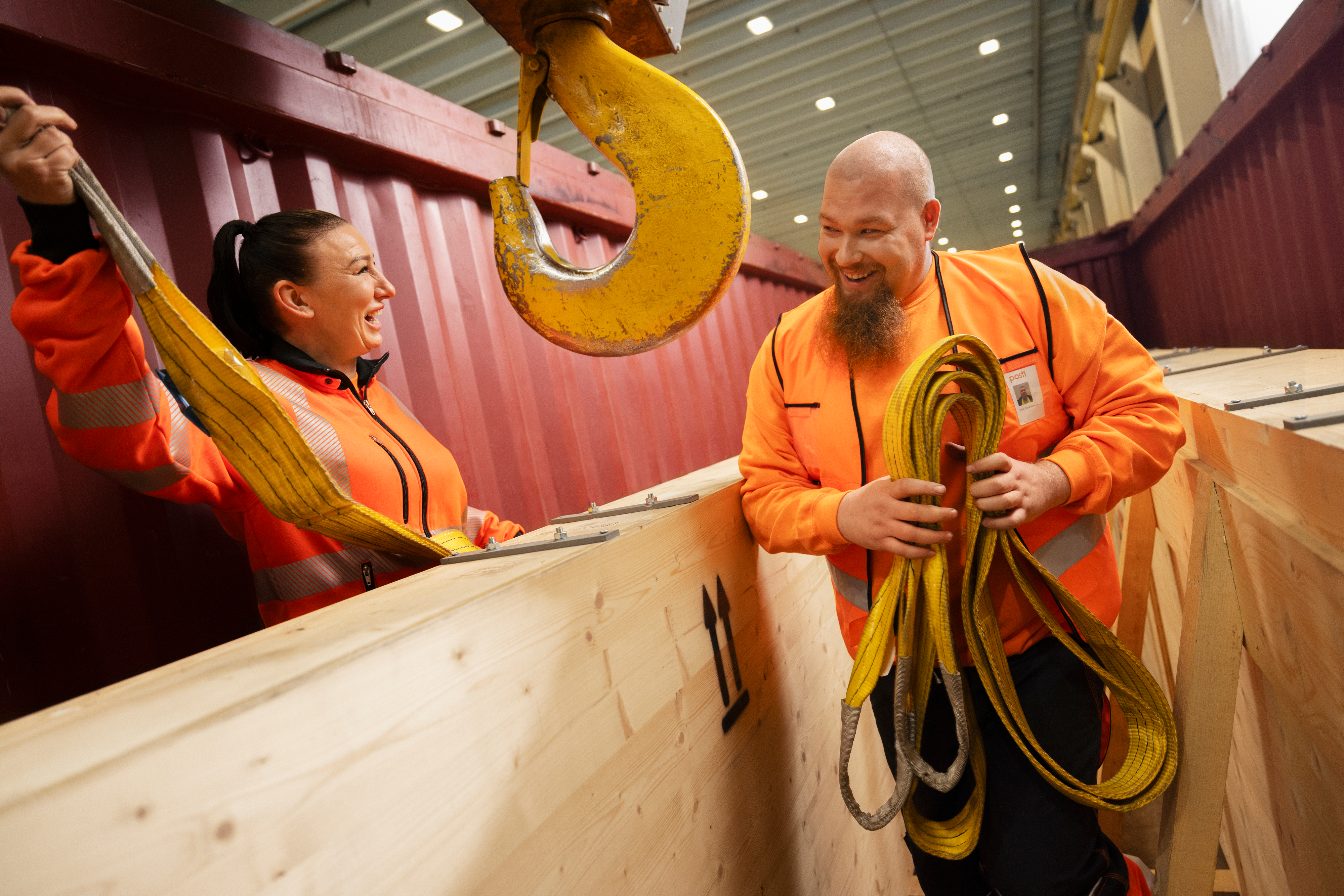
This is how Posti’s on-site logistics service works in practice. Posti’s professionals work at customers’ premises, such as a bakery or a factory. In everyday life, Posti employees become part of the daily life of the factory.
”Many companies have outsourced cleaning, for example. We also work at the customer’s premises and enable them to use their working time for their core competencies.”
Small everyday observations can create big benefits
In the end, well-functioning on-site logistics are all about the work done by people. Even an everyday observation can become a significant thing that makes work smoother.
”It could be visual guidance to improve occupational safety or a more functional user interface.”
Identifying core competencies is the starting point of development
First, you need to identify your own core competencies.
Viljanen challenges companies to review and identify their own core capabilities.
”Once you have identified that you have an excellent ability to, for example, design and build an engine, make butter eye buns or take care of human health, you can make an informed decision about what to do yourself and what to arrange differently. This is precisely how the productivity benefits are created through the development or outsourcing of on-site logistics, for example.”
Posti familiarizes itself with the special characteristics of each company’s business so that the on-sitee logistics services can provide customers with measurable and value-creating benefits.
”The butter eye buns must be brought to the store as fresh as possible. Speed is emphasized in the supply chain. In heavy manufacturing, the end product is unique and extremely valuable. For example, the equipment used in project deliveries in the technology industry is typically the only one of its kind. The production line must be supplied with exactly the right parts and at the right pace, or there will be problems with production,” says Viljanen.
Co-development creates measurable value
On-site logistics are developed with the customer through co-development.
”We work in close cooperation with the customer companies’ development managers and develop our daily operations. An in-depth understanding of the customer’s processes helps us to further develop our operations.”
According to Viljanen, the personnel’s feedback on outsourcing is often surprisingly positive.
”When people working in in-house logistics transfer to a logistics professional, they get to focus on their competence and find that motivating.”
Partnership delivers the best results
Viljanen has come across the idea that in-house logistics could not be separated from production.
However, a good union benefits both parties. Interaction with the customer company’s personnel creates benefits at different stages of the production process.
”As developers of operations, we are an integral part of the factory’s operations, not just a physical performance. The development of outsourced on-site logistics rarely reaches its full potential through the initiative of the service provider alone. The best results are achieved through a genuine partnership, in which both parties actively participate in the development of operations.”
Development work requires goals and monitoring
The annual development day is often the key tool for managing development work. During the day, the focus areas for long-term development are identified and prioritized together.
Based on these, concrete development projects and goals are defined, and their progress is planned, implemented and monitored together through steering group work, for example.
Posti has been involved in numerous on-sitee logistics outsourcings. Professionals have made one key observation about them.
”When on-site logistics employees have transferred to a logistics professional, they have felt like they have come home. The positive feedback has been about the fact that they can influence the development of work.”
Employees’ observations are the basis for continuous improvement
Development can also start with the everyday observations made by employees. For example, a packer may notice that the materials to be packed could be a little lower on the shelves.
”A small thing can affect many things: occupational safety, comfort and efficiency. When the small thing is scaled up, its impact increases. At the same time, the employee feels included in the supply chain of the product.”
Technology brings benefits only on a strong foundation
Viljanen emphasizes that it is important to look at future needs in addition to measuring operational actuals. Technologies can offer new opportunities to anticipate material flows and build better visibility into future demand.
He points out how the use of artificial intelligence, machine vision or robotics only brings measurable benefits in logistics when the existing systems and data, i.e. ”the foundation is in order.”
”Many companies still have a long way to go before they can gain benefits,” says Viljanen.
On-site logistics is still of an ”unknown magnitude”
Although, according to Viljanen, the manufacturing industry’s development investments are often focused on products and production, there is also considerable potential for improving productivity in the development of material flows and on-site logistics.
”On-site logistics is of an unknown magnitude. The efficiency of the customer’s own production increases when the products are delivered to the technician on time, the finished product is delivered to the client on time and the environment is maintained from the point of view of production. More can be achieved with the same resource. By outsourcing on-site logistics, the company also makes fixed costs variable."
According to a customer survey commissioned by Posti, approximately 70 per cent of companies are willing to outsource more of their logistics over the next five years.
”The most significant reasons are reducing costs and improving their own productivity. Companies become interested in outsourcing when they identify what kinds of qualitative improvements it can achieve and how it can free up time for core competencies.”
Long-term development builds strategic partnerships
Posti’s longest on-site logistics customer relationships have started in the 1990s. At its best, long-term joint development leads to strategic partnerships.
”In the cooperation that started this year, the customer thanked us for our willingness to be a partner that genuinely develops material flows on site.”